Thursday, May 13, 2004

If you're looking for evidence that the Vatican is a political rather than a moral entity, you need look no further than this (article in German).

Vatican: Torture Worse Than September 11th


The abuse of Iraqi prisoners by US soldiers is, by Vatican lights, a greater blow to the United States than September 11th. Vatican Foreign Minister Archbishop Giovanni Lajolo told the Italian daily "La Repubblica" that the abuse scandal fuels the hatred of Arabs for the west and, above all, Christianity. (...) The torture scandal makes it even more important that the UN intervenes in Iraq and the US gives authority to Iraqi's as quickly as possible.


It's worth noting that Archbishop Giovanni Lajolo seems entirely preoccupied with political consequences of the two acts and with advancing the Vatican's political agenda (strengthen the UN, weaken the US). Nowhere does he evidence the slightest concern for the immorality of killing more than three thousand innocent people.

Monday, May 10, 2004

A Long and Interesting Read.


The Taguba report is available at GlobalSecurity.org.


The report is detailed and hard-hitting and should put paid to any notion that such abuse is typical or that the military is attempting a coverup. It won't, but that's just politics in an election year (and the press running with the narrative they prefer).

Sunday, May 09, 2004

Cognitive Whiplash


If rumors of child abuse at Abu Ghraib turn out to be true, I tend to favor this suggestion, not just because it is appropriate (assuming a very high standard of proof is met) but because of what would likely follow.


In the immediate aftermath, the perpetrators of such heinous acts would be justly condemned by pretty much everyone. The European political class (and much of the American left) would, with their typical hyperbolic flair, go much further -- breathlessly placing them on the chart of historical evil-doers somewhere between Hitler and Pol Pot (though still well below President Bush himself).


Once the offenders were sentenced to death, however, the chattering classes would be required by canon to lionize them as heroes (see: Mumia).


One can only hope that such a rapid transition from "evil incarnate" to "poor, innocent saints" produces enough cognitive whiplash to snap a few necks.


Thursday, May 06, 2004

Rachel Lucas comes out of hibernation, and the word "Asshat" suddenly starts appearing all over the place once again. Coincidence? We report, you decide.


In any case, welcome back Rachel - we've missed you.

Wednesday, May 05, 2004

The word 'Accountability' does not appear in the EU dictionary. MEP attention is apparently focused on the important stuff.

Friday, April 30, 2004

Go read the Messopotamian now for an idea of what was and is required in Iraq.


It'll be much harder now, but maybe it isn't too late. Unless of course the coalition really is planning to cut and run in Fallujah.

Thursday, April 29, 2004

Anti-Mullah Secret Weapon: Cooties!
Muqtada al Sadr, You're next.
On the way into work this morning, NPR was reporting a "deal" to solve the Fallujah standoff. According to NPR, US Marines will withdraw to be replaced by "Fallujah Protective Army" (or something like that) that doesn't even exist yet but which will be constructed from former military units. This so-called Army will be far less militarily capable than US units and its loyalty questionable, at best. Even if they make a good faith effort, the Neo-Baath militia will be less effective at stopping insurgents and will likely cause more damage in the process..


This deal seems like the worst possible thing the coalition could do. It would simultaneously:

  • Reinforce the impression that the US lacks the political will to follow through when the going gets rough. This will cause terrorists both inside and outside Iraq to redouble their efforts. The dictionary entry for Fallujah will read "See: Mogadishu"

  • Reinforce Iraqi fear that the US will cut and run, leaving them to the tender mercies of a new strongman. Moderate Iraqis will be even more reluctant to work on reconstruction, due to fear that they'll be persecuted for collaboration once the coalition bails.

  • Legitimize what amounts to a private militia.


  • I arrived at work both furious and depressed, where I found a report on MSNBC that the Pentagon denies that any such deal has been struck. Wretchard also has another of his typically excellent analyses of the likely military situation in Fallujah.


    Between the two, I'm a bit less worried. If Wretchard is correct (and his track record on Fallujah is very, very good) the military situation is close enough to a tipping point that the political manuvering won't matter.


    In my most optimistic moments, I can imagine that the announcement of a deal is actually an elaborate psy-op. Actually building a New Baath Army is a really bad idea, but as a threat it seems pretty effective ("work with us, or we'll hand the keys over to the UN and a cadre of ex-Baathists"). I can't say that I genuinely believe that right now, though. We'll see how things play out over the next few days.


    Update: MSNBC is now also reporting the possibility of a New Baath Army (also now in the article linked above).


    Update: George Willl agrees and Andrew Sullivan is worried too.

    Monday, April 26, 2004

    Signs of Weakness


    This is interesting:


    In a written statement the group released with the tape, it demanded Italian citizens organize demonstrations against the presence of Italian troops in Iraq.


    The group gave Italians five days to organize the demonstrations. Otherwise, the statement said, the hostages would be killed.


    Notice that they aren't calling for the removal of Italian troops or any action by the Italian government, just for street protests in Italy. This is interesting and a good sign in a number of ways.


    First off, I get the feeling that world reaction to Fabrizio Quattrocchi's heroic defiance has them a bit reluctant to execute any more Italians. More importantly, it means that whoever is holding the Italian hostages has decided that they're not going to get what they want from the politicians, so now they're trying to undermine them with a direct appeal to the electorate (while looking for a face-saving way to declare victory).


    Does anyone know if the usual suspects are organizing a puppet show demonstration?


    I think (and hope) the hostages will come home safely regardless, but this move becomes a significant tactical setback for the kidnappers if they end up completely empty-handed. Right now Al Qaeda, et al are trying to train the European public to appease (or, more properly, reinforce their training to appease) and any example of Europeans successfully standing up to terrorist pressure will undermine the appeasement reflex that has been developing so nicely.

    Wednesday, April 21, 2004

    Kick Me
    I'm afraid I don't understand all of the rejoicing about European leaders rejecting Osama's "truce" offer. Of course they'll all say that -- even Zapatero tries to pretend that he isn't just cutting and running.


    The real test comes after they succeed in another major attack in Europe. Will the voters of whichever country is hit (Italy is my guess) stand by their man, or will they denounce him for not accepting bin Laden's generous terms?


    I'm usually an optimist, but in this case I'm betting on form.

    Wednesday, April 14, 2004

    Bad news, good news


    The bad news is that a handful of unidentified Leipzig residents have filed a lawsuit to stop a planned Jewish community center on the grounds that it poses a security risk due to the likelihood of attacks.


    The good news is that the citizens of Leipzig have rallied broadly in support of the community center since the lawsuit became known, with hundreds of supporters at a community meeting and more than a thousand signatures on a petition in support of the community center. "It's scandalous to argue that the Jewish community is a security risk," says Pastor Christian Wolff of the Thomaskirche. "We've had 'Jews are a danger' before," he notes.


    If only the EU were as clear-headed and straightforward as Pastor Wolff and the citizens of Leipzig.


    Update: Here's another straightforward denunciation of terrorism. German bishops used Easter sermons to denounce any attempt to justify terror acts in God's name, describing such acts as "absolutely perverse."

    Sorry to just disappear like that, but work and life both got suddenly hectic in a big way. I can finally see the light at the end of the tunnel and will be back soon.


    In the meantime, keep an eye on the German media with Medienkritik, read Belmont Club or Intel Dump for great coverage of all things military and the ongoing turmoil in Iraq, or go help Michele help the Marines help Iraq.

    Wednesday, April 07, 2004

    Ur Tax � @ Work


    A European MEP with too much time and too few clues has translated part of the draft constitution into "SMS" language, in a horribly misguided attempt to make it more accessible to youth.


    Leaving aside the fact that he's misappropriating a jargon that he's mistaken for slang, this guy sounds like an aging hipster making a desperate and embarassing effort to prove he's still cool and in touch with todays youth.


    Update: No, this doesn't appear to be an April Fools joke. At the very least, the EU Observer article and the Lib�ration article it references are dated 7 April.

    Tuesday, April 06, 2004

    If you're intent on handicapping the Presidential election at this early stage, it helps to consider the Feiler Faster Thesis and the effects of campaign finance reform.


    The good news is that we won't have to face "seven more months of this." The bad news is that we'll be facing something much, much uglier starting in August.


    The first thing to keep in mind is that it's still very early in the cycle. Nobody is actually even trying for a knockout blow yet; both campaigns are trying to harden their own defenses and soften up the other guy in preparation for the real attacks that will come later in the cycle.


    That's not to say that the polls are irrelevent. Neither campaign can afford the perception of a sustained large decline, so both campaigns intervene as necessary to kill the other guys momentum. The end result of all of this manuvering is the back-and-forth seesawing we've seen for the past month or two.


    The Bush campaign has more money than the Kerry campaign, but the Democrats have a lot more money in "527 organizations" like MoveOn. The 527's are much less constrained than the Kerry campaign itself, since they can go negative with a lot less blowback onto the candidate. The downside to the 527's is that their activities are extremely restricted within 60 days of the election.


    There's all kinds of manuvering in the courts to change the rules governing 527's but, assuming nothing changes and there are no dramatic surprises elsewhere, here's what we have to look forward to:

  • Another couple of months of sniping and mudslinging. Both sides are doing better on offense than defense right now, so they're likely to keep hammering at the same targets. The Bush campaign will drive home the message that Kerry waffles and panders, is a big spender and is weak on defense. Kerry will keep grinding away at the perception tha Bush is stronger on defense and will push "Bush lied" for all that it's worth.

  • Starting sometime in August, the assorted 527's will empty their coffers (use it or lose it) and we'll be treated to a huge, extremely negative anti-Bush blitz. The handful of Republican 527's will respond in kind, but Bush himself is likely to hunker down and try to ride out the storm. He'll fight back if things get too far out of hand, but September should see a low point in the polls for Bush.

  • Once the 527's are out of the game, the dynamics change (mostly) to Bush's advantage. Probably most important is the fact that the Bush campaign has more money. The fact that the candidates will have to personally affirm the contents of their ads is also significant, as it means that both candidates will have to choose their attacks carefully. Bush has more latitude here since he usually comes across as folksy and genuine when he delivers a smackdown while Kerry mostly sounds strident, condescending and/or fake.

  • Washington will shut down as neither side will want to give the other ammunition or a free stage. High profile Democrats like Teddy Kennedy will continue go on the attack on behalf of Kerry, but I'm not sure how effective they'll be.

  • From September on, it's a (probably mostly tactical) slugfest, the details of which depend largely on what happens to the economy and in Iraq. If the economy clearly improves and Iraq is under control (not unlikely in November, despite the chaos right now), Bush has a strong advantage -- Kerry's only hope is to go extremely negative, and that is not his strength. If the economy is still mixed, or if Iraq is still a mess, Kerry's job is a lot easier.


  • In short, I expect the race to stay close and ugly right up until the end, with a low point for Bush in September followed by a gradual and uneven climb until election day.


    All of this assumes no dramatic surprises. If a convincing stash of WMD's turns up somewhere (e.g. in a suddenly cooperative Syria), a lot of Bush negatives disappear. Another major terrorist attack in the US could theoretically go, but I expect that the press would turn it to Kerry's advantage (as they did with the Clarke book and the 9-11 hearings). Thwarted major attacks, or successful major attacks in Europe would probably work to Bush's advantage. And so on...


    We're in for some interesting times and, given that I'm already sick of this campaign, I mean that in the worst possible way.


    FWIW, I suspect that Bush actually does have something up his sleeve. His defense has been so weak on both the 9-11 hearings and the question of WMD's, that his opponents are piling on ever harder. Every time he's seemed this beleaguered in the past, he's executed a perfect political judo move that sends his opponents sprawling under the weight of their own assumptions. That's purely a gut feeling at this point, though, so don't ask where it'll come from or what form it'll take.

    Tuesday, March 30, 2004

    Dick Clarke, Man of Action


    Spiegel descends (further) into parody, and drags the New York Times along. Here's their description of the events of September 11:


    The entire capital seems to be on the run. Government departments, offices and official agencies are cleared, and emergency response centers are activated throughout the country. In the center of the eye of the hurricane, in the White House situation room, a room bristling with monitors, Richard Clarke, a hero and the President's special counter-terrorism advisor, takes control of the situation.


    Throw in a square jaw and steely glare, a couple of heaving bosoms and a bag of popcorn and we're set for the evening. Dick Clarke action figures will no doubt be appearing in toy stores across Germany very soon now.

    Despite having a rough month, President Bush's odds are holding up well on the Iowa Electronic Markets and Ideosphere's FX (an idea futures game that doesn't use real money). Glenn Reynolds wonders what information the market participants have that the conventional wisdom does not.


    I think we're seeing a difference in focus rather than information. The futures markets focus on the eventual outcome, while day to day jostling drives the conventional wisdom.


    If we accept the Feiler Faster Thesis, frequent reversals of fortune are par for the course these days, which means that any one setback is largely irrelevant. Barring an unlikely knockout punch (e.g. the Dean scream), this back-and-forth will continue right up to election day.


    The markets have taken that into account, and they're discounting the tactical advances and setbacks as largely irrelevant. Unless a clear longer term trend emerges, they'll continue to reflect the underlying economic reality (pretty good, actually) and projections for the situation in Iraq (which I for one expect to be a lot calmer 6 months from now).

    Monday, March 29, 2004

    Post-Madrid, this kind of statement is reckless. However Romano Prodi intends it to play, the terrorists will hear a practical invitation to "intervene" bloodily on his behalf in the upcoming Italian elections.

    Friday, March 26, 2004

    Keep his day job?


    It's entirely possible that President Bush just didn't anticipate the negative reaction his "where are the WMD" routine would get from the chattering classes opinion leaders, but it could well be that his detractors are misunderestimating him once again. It sure looks to me like Bush is happy to keep the issue of WMD's alive without really addressing it. Yet.


    I have no idea what form it will take, but I suspect there's another rope-a-dope coming. After all, Bush has a long history of suckering his opponents into overcommitting on shaky ground, even if doing so makes his supporters really nervous.


    Note: This is not a paranoid conspiracy theory and I don't think anyone is sitting on a hoard of WMD's (or bin Laden) and waiting for the right moment to announce them.


    As his critics work themselves into a frenzy, they lower the bar for Bush. Six months ago finding "only" small stockpiles would have been a disaster, two months ago they would have been a victory. Today, finding anything at all would be a triumph.


    In fact, his critics have since made so much noise about his "silence" on the issue (and, now, about "not taking it seriously") that a convincing and straightforward explanation of what went wrong (and right) on the subject of WMD's would end up being enough of a win for the President to take the issue off of the table.


    Update: Hmmmm.


    Update: Dean Esmay thinks there's a rope-a-dope coming on Condoleeza Rice and the 9-11 commission, too.


    Update: Donald Sensing wonders too.

    Thursday, March 25, 2004

    Wolfowitz on Clarke, from the Washington Post transcript of Tuesday's 9-11 hearing:

    By the way, I know of at least one other instance of Mr. Clark's creative memory. Shortly after September 11th, as part of his assertion that he had vigorously pursued the possibility of Iraqi involvement in the 1993 World Trade Center bombing, he wrote in a memo that, and I am quoting here, "When the bombing happened, he focused on Iraq as the possible culprit because of Iraqi involvement in the attempted assassination of President Bush in Kuwait the same month," unquote.


    In fact, the attempted assassination of President Bush happened two months later.


    It just seems to be another instance where Mr. Clarke's memory is playing tricks...


    I don't think the administration is covering themselves with glory in this whole process, but apart from his carefully scripted "mea culpa but they-a more culpa" Clarke hasn't been doing any better -- when he isn't actively contradicting himself or making statements that are verifiably false, he's going way out on a speculative limb, based on his memory of intangibles like body language. We have ample reason to suspect his memory is less than 100% reliable.


    Perhaps that's not fair. Maybe his memory is just 100% reliably guided by whatever narrative he's settled on at any particular point in time.


    You wouldn't get that from most of the press coverage, though. Wolfowitz's comment seemed to me like a pretty solid hit on Clarke's credibility, and the folks in the room seem to have had the same reaction. Here's the next questioner:


    LEHMAN: Thank you.
    Mr. Secretary, I hesitate to cite Mr. Clarke as an authority after the last exchange.


    (LAUGHTER)


    But it seems to have gone completely unreported. I went looking for this snippet because I happened to hear it and was a little surprised (okay, not really) that it didn't even rate a mention amidst the breathless accounts of how "Clarke KO's the Bushies"

    .
    Update: Here's a clue: Fred Kaplan (the author of the hit piece cited above) and about 15 other well-known journalists have actively helped Kerry refine his message during the campaign. Is it any wonder that "his" media-crafted message finds purchase with the media?

    Monday, March 22, 2004

    The Daily Stern


    Sure, it's fun to wear the mantle of the politically oppressed, especially when you get to do it on hundreds of radio stations in front of millions of listeners.


    But if you want to see real political suppression of a Stern, you'll have to go to Brussels, where the Bureau chief for the German news magazine was arrested last week, held incommunicado, and questioned without a lawyer present (all legal under Belgian law). I'm sure that it's the merest coincidence that the Mr. Tillack is best known for reporting on corruption in the EU.


    Stern's own article (in German) about the arrest of their Bureau chief is here.

    Economic indicators?


    We went to a local mall (Bellevue Square) this weekend for the first time since last year, and were stunned to discover how much it has changed.


    Last year, store fronts were empty and remaining stores were closing. Parking wasn't a problem, even at Christmas, and the Teddy Bear statue in front of the shuttered FAO Schwartz loomed over empty halls. It was palpably downbeat and a little depressing.


    Yesterday, we had to hunt for a parking spot. The sad and looming teddy bear is gone - replaced with a shiny and well-trafficked new "Express" - and the other empty store fronts have all been filled (though some are still under construction). There were a lot more people about than I've seen in a long time.


    Anecdotes aren't worth much, but it certainly didn't feel like hard times at the mall this weekend.

    Friday, March 19, 2004

    One Year Later...


    A look at the photo retrospectives out there, one year after the start of the war.


    It's... interesting... to compare the photos selected by Iraqi bloggers:

  • Sarmad

  • Zeyad


  • To those chosen by the mainstream media:

  • Tagesspiegel

  • International Herald Tribune.


    If you come across photo galleries from other sources, please send links and I'll put them up.


  • Thursday, March 18, 2004

    If Poland wasn't next on the terrorist hitlist before, it is now.


    This is just the wrong time to be saying things like this. Regardless of the merit of the underlying sentiment, this looks like is wavering resolve in the face of terror.


    Facing an enemy who now seems to be thinking much more strategically, Poland has just advertised itself as the next weakest link in the chain.

    Wednesday, March 17, 2004

    How to train a dog


    If he misbehaves, whack him on the snout.


    Patiently explain what is expected of him.


    If he behaves, give him a treat.


    Now we'll see if Zapatero earns his obedience school diploma.


    Much as I'd like to see him say "In that case, we'll leave our troops in Iraq," it isn't going to happen. The best thing he can realistically do is point out that he's been talking about pulling out of Iraq during the whole election and the fact that the terrorists got what they want is an unfortunate accident, rather than a direct effect of the bombing.


    If he's as dumb as I think, Zapatero will use this letter as yet another excuse to rant about Bush and Blair. If he's even dumber than I think, he'll use it to pat himself on the back for "making Spain safer" or some such, thus strengthening the notion that countries can, and should, accomodate themselves to terror.


    Update: The authorities are skeptical of the letter. Maybe Zapatero will just ignore it, which would at least not make things worse.

    Threat level Scarlet?!
    Tucked in this report about the love threatening letters France is receiving from their Islamist buddies is a tidbit I found amusing:

    Berthomet said France had already hiked its security precautions up to "red" level, the highest it could do without unleashing draconian measures in the top "scarlet" level.

    What are the other levels? Chartreuse? Puce?

    Tuesday, March 16, 2004

    As disappointed as I am about the results of the Spanish election, I think we should cut the Spanish Electorate some slack. A large minority voted for the PP and that the vast majority of the people who voted for Zapatero were already planning to vote do so before the attack. In the end a relatively small portion of the electorate -- perhaps enough to sway the election, but still a small percentage -- were affected by the bombing in one way or another. The number that were actually voting for appeasement or out of fear is unknown (and probably unknowable) but likely rather small.


    Every voter takes a personal constellation of priorities into the booth with them, and most votes are a compromise and inherently ambiguous. To label the entire Spanish electorate or population as cowards or appeasers is an unfortunate slur.


    To call Jose Luis Zapatero a fool and an appeaser is, on the other hand, completely appropriate.


    The election result itself was ambiguous, and had Zapatero just focused on domestic policies until the wounds from the 3-11 attacks weren't so raw, he could have softened the connection between the bombings and changes to Spanish policy. Even if he later chose to remove the troops in Iraq the link to the bombings would have been tenuous enough that some doubt would always have remained.


    Instead, Zapatero wasted no time resolving any ambiguity with his short-sighted and disastrous grandstanding. By immediately promising to remove troops from Iraq and very publicly spewing bile at Bush, Blair and Aznar, Zapatero made it crystal clear that he would dance to the terrorists tune and that his victory in the election was a triumph for the murderers who carried out the attacks and for terrorism in general.


    The people of Spain did not choose appeasement, but Jose Luis Zapatero did.


    Innocent victims around the world will be paying the price for his choice for years to come.


    Update: This is what I mean. Don't blame all Spaniards for the folly of a few.


    It seems to me that the underreported rest of Kerry's "foreign leaders" quote is actually more damning (though less entertaining) than the part that's getting all the play. The way I read this, John Kerry is openly and actively encouraging foreigners (worse yet, foreign "leaders") to launder donations to the Kerry campaign through expat intermediaries.


    From the Opinion Journal:


    Kerry: "I've been hearing it, I'll tell ya. The news, the coverage in other countries, the news in other places. I've met more leaders who can't go out and say it all publicly, but boy they look at you and say, you gotta win this, you gotta beat this guy, we need a new policy, things like that. So there is enormous energy out there. Tell them, wherever they can find an American abroad, they can contribute," a reference to donations, prompting laughter from the crowd.


    Having lived in Europe for years I have no doubt that there are plenty of expats who would happily "pass along" donations from locals who want to unseat Bush, but that doesn't make it legal or right.

    "Support me, I'm Gullible"
    Glenn's suggested slogan for John Kerry ties in nicely with something I've been thinking for the past couple of days.


    It's fun to speculate about Kerry's imaginary friend the "World Leader," but to me it's at least as bad if his claims are actually true.


    What exactly does Kerry think that world leaders are telling President Bush in their "private conversations"? That they hate him and hope he loses?! I'm sure that any world leader that talks to either of the candidates is schmoozing for all he's worth, just to keep the bases covered (except maybe Zapatero, who seems to be channeling Chavez and who wasn't a leader yet when Kerry made his claim).


    Is Senator Kerry naive enough to genuinely accept statements like that at face value, without considering the possibility that he's being schmoozed? Or is he politician enough to know better and just assuming that the American people are dumb enough to blindly accept that sort of assertion?


    If he's coming to a "town hall" near you, could you do me a favor and ask him for me? It doesn't look like he'll be in my neck of the woods (greater Seattle) any time soon, or I'd ask him myself.

    Slowly coming back to life...
    Sorry for the unannounced long hiatus. I had a near-job death experience in June, followed by an intense job search that ended in a great new position that's also a lot more demanding (read: time consuming) than the previous one was. Add a new baby to the mix (she's adorable!), and more than six months of "no time to post" passed in the blink of an eye...


    I've been getting that itch again, though, and time is loosening up enough that I should be able to sneak in a few hours here and there.

    Thursday, June 05, 2003

    "Send In Your Dead..."


    The Guardian is collecting obituaries of people who died in Iraq for a "Memorial" page. I suggest that anyone who has stories about Saddam's pre-war victims send those in as well so the "memorial" isn't so one-sided.


    I spent two hours arguing more-or-less this topic with four Europeans today (Spanish, German, Italian and Ukrainian - there just has to be a joke in there somewhere), and they seem to be constitutionally incapable of considering in any way, shape or form any harm that isn't caused by war. In their world, "Not War" is always better than war, even if "Not War" leads to far more death and suffering or even mass graves full of children.


    It's a point of view I find incomprehensible and it was a disheartening experience -- these are genuinely nice, intelligent people who I like a lot, but they have blind spots you could sail an aircraft carrier through. Including Saddam's victims in the Guardian's "memorial" is one small way to make it harder for them to ignore the suffering caused by inaction.

    Tuesday, June 03, 2003

    Crime and Punishment


    A 13-year old in Munich who lives in a home for troubled youth and is "well known to the police" stabbed a retiree with a "weaponized" kitchen fork so hard that it stuck in his skull. He was caught at the scene and has openly confessed, but (according to the S�ddeutsche Zeitung) due to his age the police were forced to release him at the scene and he has absolutely nothing to fear from the courts. He is literally unpunishable due to his age.


    Unbelievable.

    Send The Marines!


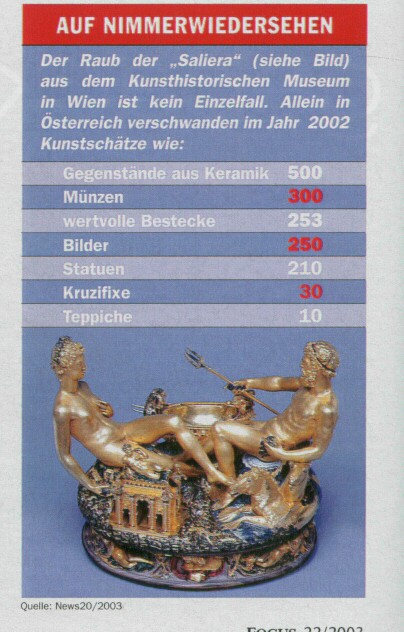
    This graphic (from last week's Focus magazine) summarizes the ca. 1500 pieces of artwork that have gone missing in the year 2002 in Austria alone. Clearly, there aren't enough US troops patrolling the streets of Vienna.


    Saturday, May 24, 2003

    Is this one of the entrance criteria?


    10 11 things I learned from the Eurovision Song Contest:

  • When picking sides for Eurovision, leave the lounge singers at home.

  • Germans still like Groenemeyer, even when he's Polish.

  • The world isn't ready for an Estonian-led 80's revival.

  • Sweden has not exhausted its supply of Abba.

  • Britney Spears has a twin in Romania.

  • The hills of Greece are a sight to behold.

  • The Multi-Culti has run through all existing cultures and has to invent new ones to promote.

  • Teeny-bopper lesbianism still sells. Even if the music sucks and they don't kiss.

  • Profound-seeming pseudo-multiculturalism sells even better than teeny-bopper lesbians. Go figure.

  • A Eurovision-style voting system (in which people can't vote for representatives of their own country) would be much better than any of the propsals for the new EU constitution.

  • The continent is still sore at the UK, but they're really sorry about that whole NATO/Turkey thing

  • Sunday, May 18, 2003

    Leading Indicator


    Do you find it hard to stay ahead of the tin-hat crowd? Don't have the time to wade through DU or Indymedia to find the latest paranoid conspiracy? Don't have the stomach for Ted Rall? Have I got a blog for you!


    Horst Prillinger (The Aardvark Speaks) seems like a smart enough guy who reads a lot and makes lots of connections (he is a librarian, after all). He also seems to have a blatantly paranoid anti-American streak.


    What that means to you, dear reader, is that you now have a bellwether for the tin-hat crowd -- a resource who will comb through the news and the nonsense to find the most spinnable pieces, from which he constructs clever and interesting conspiracy theories.


    When he isn't engaged in flights of fancy, he provides an interesting window into the kind of paranoid anti-Americanism that's being spoon-fed to the European public. When his imagination kicks in, you'll be treated to some of the more interesting and superficially plausible anti-American conspiracy theories on the web.
    His track record for spotting the theories with legs is pretty good:


  • On April 16, Horst asserted that looting at the Baghdad Museum was instigated by American troops at the behest of a shadowy cabal of American art collectors that apparently controls the Pentagon. With that, he jumped straight to step seven of the logic chain predicted by Jaed at Bitter Sanity (sadly, she's apparently on hiatus).

  • A full month ago, he was pimping today's hot anti-American gossip item - that the rescue of Pfc Lynch was staged. He even alluded to the possibility a week earlier. Sadly, nobody picked up on this little gem at the time.


  • Unfortunately for Horst, his track record for theories that, say, correspond with reality is less than stellar. The looting of the Baghdad Museum turns out to have been much less serious than originally reported and was likely conducted by members of Saddam's people. The Pfc Lynch "Wag the Dog" smear campaign is a fantastic concoction even further from the facts than the Museum story was and will likely die a quick and painless death.


    But not quite quick or painless enough. Blogosphere fact-checking can kill a story within days, but a prebuttal like Jaed's can spike it before it emerges. And that's one good reason that it's useful to monitor blogs like "The Aardvark Speaks."

    Saturday, May 17, 2003

    It's nice to see that Germany is trying to patch things up, as predicted:

    I expect that sanctions will be lifted quickly," said Schr�der. "In the end, this is about the people of Iraq, who must be helped as soon as possible."


    Schr�der and company seem rather put out, though, that the administration isn't friendlier. They'll just have to get over that -- Bush won't take any substantive actions against Germany (base closings are sensible, not punitive), but he's not the kind to forgive and forget. Relations will remain proper but cool for as long as Schr�der (and Bush) are in power. That said, Bush probably shouldn't be flirting quite so openly with the Union -- It's improper and it's likely to backfire.


    Now we'll just have to see what France and Russia are up to. Russia is quietly belligerent but seems to be hinting that it will accept bribes. France is just freaking out, which could have several causes:

  • An attempt to preemptively discredit information they fear will be coming out of Iraq

  • An attempt to score sympathy points in preparation for a new round of strife at the security council

  • A sudden realization that the breach is serious and that Bush isn't going to kiss and make up ever any time soon.


  • Time (i.e. the next week or two) should tell.

    Wednesday, May 14, 2003

    Friday, May 09, 2003

    Payback's a Bitch


    It's perfectly appropriate for countries that opposed the war in Iraq to suffer some consequences now that the war is over, but it's extremely important that those consequences are reasonable and appropriate. Petty snubs or heavy-handed revenge would backfire badly.


    I outlined some appropriate responses some time ago, but I have to confess that I never expected this (despite actually suggesting something similar).


    It's perfect -- simultaneously unassailable and galling to the weasels, and it establishes Poland as a serious player in intra-European politics.

    Thursday, May 08, 2003

    Broken Axis


    The Franco-German Axis of Weasels is nearing its end. I expect Germany to leave the Weasel-bloc during the looming UN showdown over removing sanctions against Iraq; Unless Chirac is exceptionally clever, Bush is exceptionally clumsy and Schr�der decides he has nothing to lose, Germany will stay on the sidelines this time around.


    Germany now has more to gain from mending fences with the US than from poking Bush in the eye again and Germans are waking up to that fact. It's also true that a genuine pacifism (cynically exploited) was the primary force behind German opposition to the war, and it will be much harder to incite a pacifist frenzy to leave sanctions in place, particularly if doing so means further deprivation for the Iraqi people.


    Chirac, on the other hand, is as staunchly anti-American as ever and he's getting awfully chummy with Putin's Russia. For his part, Putin isn't sounding much like Bush's soulmate these days. It also seems that they're taking turns drawing attention -- when Chirac sucks up, Putin starts growling and vice-versa. Is it coincidence or coordination?


    Chirac and Putin make an odd couple and I'm not sure exactly what they're up to, but their interests might align better and for longer than it first seems.


    France wants to be a player but doesn't know how to function in a unipolar world while Russia nurses a bruised ego and pines for its lost empire. Chirac's project to forge Europe into a French-led opposing pole is looking doubtful (in the short term, at least, and even to me). If he had the opportunity, Chirac might just promote Russia as a counter to the United States, in the hope that France could resume its accustomed cold war role of amoral profiteer neutral "power."


    If it plays out exactly right for Chirac, geography, economic ties and internal bureaucratic inertia could knock all of Europe out of America's sphere.
    On the other hand, it could backfire -- cozying up to Russia could well spook already nervous "new" Europeans into even closer alignment with the United States.


    This theory fits Chirac's pattern of raising the stakes after each loss, and his clear obsessesion with constraining the United States. On the other hand, it seems like a dangerous (hence unlikely) proposition for Chirac. I don't have a better explanation for Franco-Russian amity and their continuing opposition at the UN right now, but the next few days should be ... illuminating.

    Tuesday, April 29, 2003

    Chirac is a diplomat


    And diplomacy is the art of saying "nice doggy" until you can find a rock.


    France just adores NATO according to Chirac. So I'm sure there's a nice innocent reason that France is seeking close military cooperation with Russia.

    Friday, April 25, 2003

    Sick Thought Of The Day
    Stephen Pollard wonders why Scott Ritter is rushing to defend George Galloway and speculates indirectly that Ritter might be on the take as well. I've had a similar but more distressing thought:


    Given Ritter's known proclivities, what are the odds that his "reward" wound up sharing a cell with one of Uday's discards in the Children's prison?


    It would certainly provide a more plausible motive for Ritter's five years of silence then "it can be used by those who would want to promote war with Iraq, and right now I'm waging peace."

    Thursday, April 24, 2003

    Don't count your chickens


    This sort of thing is why I think it's premature and dangerous to declare the Franco-German alliance dead. Blair seems to be betting that he can link up with like-minded leaders from both old and new Europe to contain the Franco-German axis, but that's a very dangerous bet.


    For one thing, the Franco-German stance is pretty much in line with European public opinion, which places limits on how far leaders who genuinely value the transatlantic relationship will go. Berlusconi has already retreated to the sidelines and Aznar's party looks to be in trouble in Spain, which leaves only Denmark and the Netherlands in "old" Europe. The picture is perhaps a bit better among the accession countries, but none of them sees any alternative to joining the EU. If they were forced to choose between Europe and the US, they would almost certainly choose Europe - even at the cost of ceding their foreign policy to France.


    Perhaps even more dangerous is the fact that the EU is undemocratic in the extreme. Real power rests with an unaccountable bureaucracy and a byzantine committee system, both of which are populated by the very EUrocrats and activists that have been gleefully fanning the flames of European anti-Americanism for the past year.


    And it's only going to get worse. The large and small countries don't trust each other, so the constitutional convention is constructing a system with competing organs of power, each controlled by one of the warring factions (at last count, there's a council, a commission, a presidium and a parliament, if I'm not mistaken) and given, for the most part, vaguely defined powers. The obvious outcome will be perpetual gridlock, which hands even more control to bureaucrats and unelected committees. A system like that will grind to a halt if it attempts to take any significant action, but it'll be very effective at preventing members from acting "unilaterally."


    The US needs to build real, lasting ties to its friends in Europe. Reconstruction contracts are getting all of the attention right now, but they're fundamentally short term and politically charged. Long-term structural commitments like TAFTA are far more important, even in the short term, as they provide a counterweight to the "EU membership at any cost" mentality that currently prevails among the accession and candidate countries. They will (and probably should) eventually join, but they are far more likely to fight Franco-German domination of the EU if they don't feel backed into a corner.


    Update: Somebody give this man an alternative!

    Monday, April 21, 2003

    My, but that Lileks fellow sure turns a pretty phrase:

    France is like someone who�s been given a glimpse of the future, sees himself committing suicide, and resolves to spend his remaining days making it look like murder.

    Friday, April 18, 2003

    It's All About The...Art?
    Jaed at Bitter Sanity predicts the anti-American/anti-Bush left will soon be accusing the US of being behind the looting of the Baghdad Museum. She paints a plausible progression of seven steps that will take them from an innocuous comment by a British officer to the full-blown accusation against the US.


    The "Aardvark" went directly to Go without passing the first six steps. Apparently, we're supposed to believe that a shadowy and sinister cabal of art collectors controls Pentagon war planning. Does "Big Oil" know it's been pushed aside?


    Update: Here's an interesting counter-meme in the making. Given the embarassment this incident is causing the US, Chirac's obvious desire to embarass the US and the fact that the first of the looted antiquities have turned up in Paris, this hypothesis that France was behind the looting of the Baghdad museum certainly seems to fit the facts better than art collectors calling the shots at the Pentagon.


    In fact, it would take far less paranoia than the Aardvark displays to wonder if, perhaps, French agents were instigating looting throughout Baghdad. The looting benefited France as it was embarassing to the United States and provided them perfect cover to spirit out not just antiquities but also any troublesome secret files they didn't want coalition forces to discover. According to the standard rules of tin-foil hat logic, whoever benefits from an action must secretly have instigated it, so this one is pretty much a slam dunk.


    An alert reader points out that it looks like the looters had inside help and that setting up the sort of targeted looting that is being alleged would have required a pretty good pre-war network within Baghdad. Which France had and America did not. Draw your own conclusions.

    Wednesday, April 16, 2003

    The Blogosphere is alight with quotable quotes today.


    If you hear of Spontaneous Human Combustion amongst the anti-war left, check to see if they've been reading Stephen Pollard:


    That is the thing about Donald Rumsfeld: he is right, you are wrong and you are just going to have come to terms with it.


    The Radical cites this lovely quote from a Thomas Friedman article:


    French-style constructive engagement, which is just
    a cover for dancing with dictators, is a fraud...
    Mr. de Villepin has become my moral compass:
    whatever he is for, I am against. And whatever he is against, I am for.


    Big Arm Woman has found a protest group I long to join (permalinks busted, look for "True Colors"):


    A local group called People Against Ridiculous Protests carried out the day's most tasteful protest. Founder Deke Wiggins appeared at his designated protest site in the morning, planted a sign, then departed. The sign read: "Look at all these ridiculous people."
    What Are They Thinking?


    Everybody has their panties in a bunch about Bush administration saber-rattling in the direction of Syria. It just confirms Europe's worst fears about the bloodthirsty cowboy in the White House and the press is wondering just what's going on. I can tell you two things that are definitely not going on: It's not preparation for an invasion of Syria and it's not a spillover of some internal strife in the administration. So of course those are the two lead theories in the press.


    As for what is actually going on, it's likely some combination of the following:

  • A warning shot. The Bush administration is about to engage in some serious arm-twisting of both Israel and the Palestinian Authority and they really don't want Syria and Iran encouraging recidivism amongst the Palestinians. This certainly lets Syria know that its support for Iraq has not gone unnoticed and that similar behavior will not be tolerated in the future.

  • A setup. In response to US criticism, the Syrian ambassador is on record insisting that it is the coalition's responsibility to police the border. Don't be surprised if the coalition takes Syria up on its kind offer to put lots of troops on the Syrian border. And don't be too surprised if they end up occasionally crossing the border in hot pursuit of terrorists.

  • An attempt to spook the bad guys into moving. Terrorists or wanted Iraqi officials will be much easier to catch if they're on the move than if they're hunkered down in Syria. This tactic seems to have been used against Al Qaeda with reasonable success.

  • A genuine attempt to get something from Syria. The real goal would be seriously confidential, but it could be a person or a policy change.

  • A political diversion. A strong defense of Syria will clearly require weeks or months of UN discussion. Any time and effort the weasel-bloc nations spend defending Syria is time and effort they can't spend attempting to undermine the reconstruction of Iraq. This would probably be pretty effective, since the Bush administration has demonstrated the ability to maintain a laser-sharp focus, where its opponents seem to be easily knocked off balance.

  • Political theater. Old Europe is preoccupied with the question of whose side Tony Blair is on, and it would benefit both the US and the UK if he could demonstrate his European credentials by standing up to the US on a side-issue like Syria.

  • A test. Part of the "domino" theory is that if the US is threatening enough to the bad guys it won't actually have to fight them to bring about change. The psychological impact of the victory in Iraq will only decrease over time, and getting belligerent even before the fighting in Iraq has ended has just the whiff of aggressive madness that makes for such effective intimidation. If a relatively soft target like Syria can't be scared (sort of) straight under those conditions, we probably have at least one more multiyear "rush to war" in our future. If this is what's going on, let's hope Syria blinks.

  • A media diversion. All this talk scares people, but it could also knock images of chaos and looting off the front page for the few crucial days needed to restore order. Sure, all of this talk about Syria scares people but it doesn't have the emotional impact of the images coming out of Iraq and will blow over much more quickly. That last seems unlikely to me, but I threw it in for the tinfoil-hat brigades.


    In any case, the Bush team is neither stupid nor undisciplined enough to allow this sort of thing to happen accidentally. Whatever is really behind it will emerge in due course, probably sometime over the next few days or weeks. That isn't to say that Syria is off the radar, just that no invasion is imminent.


    Update: Reader Rob Robertson points to an interesting and optimistic alternate theory, that tough talk from Washington will give Assad the leverage he needs to clean out the Baathist old guard. To be honest, I don't know what to make of this theory. It'll be interesting to see how it plays out.

  • Tuesday, April 15, 2003

    Regardless of your sympathies towards [Ll]ibertarianism (and I'm moderately sympathetic), this is pretty funny:

    Some libertarians think that a free market and small government (or no government) are the sole criteria of a free society (and so many of them blithely force their children to go to school, do chores, and generally obey their every whim). Such people are best described as libertarian statists, partly because it annoys them, but mainly because they are convinced that it is the malevolent State, rather than bad authoritarian ideas and lack of knowledge, that is the basic obstacle to human progress.

    The whole article is well worth a read.

    Monday, April 14, 2003

    Der Spiegel seems seems to accept as fact Steven Den Beste's "treachery" theory. They make the obligatory effort at preemptive spin control, but it's half-hearted at best.


    This article is apparently two weeks old already but I don't recall reading about it anywhere else (I've stopped reading der Spiegel myself).


    Update: This article in the same issue is worth a read, too. The combined arrogance and cluelessness of the dynamic duo is truly breathtaking:

  • For the first time, Schr�der and Fischer ... have taken the bold step of formulating policy that extends into the future. (ed: a stunning innovation, that)

  • Chirac: "They thought they would be greeted as liberators and that the regime would collapse like a house of cards. But they underestimated Iraqi patriotism. They would have been better off listening to us." ... Nonetheless, the French president explained to his advisors in the Elys�e Palace that France cannot descend into an I-told-you-so attitude.

  • The US military appears to be stuck in its tracks in the desert, and civilian casualties are multiplying. It has never been so painful to have been in the right, murmurs the foreign minister [Fischer], with a worried look on his face.

  • According to French diplomats, Blair, unlike Bush, is a true moralist, one who places great faith in the law, justice and international consensus. (emphasis mine - life imitates Scrappleface)

  • The Chancellor guides the fate of the country, negotiates with the French and Russians, and tells the stubborn George W. Bush exactly what he thinks...

  • At a recent internal meeting, a Fischer confidante spoke of a "Tour de France approach": "Always make sure you lag just a little behind."


  • That last is my favorite. It amounts to a blunt admission that Schr�der is Chirac's poodle, albeit with a forlorn attempt to paint a happy face on it.

    Comments are broken for the moment. Field circus has been summoned but there's no ETA just yet. Feel free to send email instead.
    I'm not the only one who worries that Old Europe will retain or even expand control over the levers of power in the EU. Over at Samizdata, David Carr cites a Telegraph article by Conservative MEP David Hannan that makes esssentially the same argument. Excerpts:

    A false and dangerous idea is taking hold in Britain, especially among Euro-sceptics. It goes something like this. The Iraq war has wrecked plans for closer European integration. It has set Old Europeans against New ones, driven Britain back on the Anglo-Saxon world, reminded everyone of how much they rely on the Americans, and made the idea of a European Army seem laughable...


    The trouble is that Euro-fanatics are prone to the same impulse. For them, the war is the strongest demonstration to date of why Brussels needs a unified foreign policy. Never again, they say, should the EU be enfeebled by internal divisions. Never again should Europeans be forced to watch in frustration as the Americans give some tinpot dictator a good kicking. Never again should London be allowed to behave in so non-communautaire a fashion....


    My point is not that either interpretation is right or wrong. Rather, it is that the Euro-zealots, unlike the sceptics, are in a position to act on their concerns...


    This battle can still be won, but it isn't over yet. Be very careful about declaring victory prematurely.


    Update: More fuel for the fire ("Fischer eyes EU foreign minister post").

    True Colors
    German Foreign Minister Joschka Fischer's true colors were inadvertently displayed by a Danish documentary which followed Anders Fogh Rasmussen during the four months he held the rotating EU presidency.

    "I am a good friend of Joschka, and he tells me, that Turkey will never join", says the Danish foreign minister Per Stig M�ller in a corridor passage which was taped and used in the film.

    Can we get moving on TAFTA already?

    Sunday, April 13, 2003

    Rope-a-dope


    Get ready for the next Bush rope-a-dope, folks. I'm listening to the Al-Jazeera shill on CNN now. She's figured out that they won't be able to milk the looting much longer, so she's ramping up for the next crisis and ranting about Chalabi being installed as a US puppet. I predict that about the time the Arab and European press get themselves worked into a lather about the evil treachery they're absolutely certain is coming, the Bush team will cut their legs out from under them with a surprising announcement of some kind.


    I don't have a clear idea at the moment what that announcement might be, but I seriously doubt that the US would just install Chalabi (or anyone) in a position of actual authority (he might have some sort of advisory role).


    Update: Actually, Chalabi might be the second upcoming rope-a-dope. All the noise about Syria seems to be building up a head of steam much faster, so that might well be where we'll see the first surprise.

    Huge News


    This is huge news:


    Israel will hand over some Jewish settlements in the West Bank for peace, but the Palestinians must give up on their key demand for refugees to be allowed to return to their former homes in Israel, Prime Minister Ariel Sharon said in an interview published Sunday.


    ...


    The US-led war on Iraq "generated a shock through the Middle East and it brings with it a prospect of great changes," Sharon told Haaretz.


    "The Arab world in general, and the Palestinians in particular, have been shaken. There is therefore a chance to reach an agreement faster than people think," Sharon said.


    However, whether peace is reached depends on the Palestinians, he said, adding they must first change their leadership and battle terrorism.


    Viewed by Israel as a moderate, Mahmoud Abbas, the Palestinian prime minister-designate, could be the key to a possible peace deal, he said.


    I also view this as evidence that the, um, conversation I predicted has already taken place. I'll wager that Bush gave Sharon an ultimatum to make this offer, and Abbas an ultimatum to make and enforce a similar as-yet-unknown concession. This is a test for both of them and Bush will be tough on both of them to play ball.


    Update: The Guardian's "diplomatic editor" disagrees with me.

    Here's an interesting little tidbit tucked in a doom-and-gloom MSNBC article about unrest in Baghdad:

    Last week the pro-Saddam thugs turned their weapons against crowds of local residents in a final assault against civic order. They were instructed to kill and bomb civilians in Saddam City to create chaos, says the hospital�s director general, Moafaq Gorea. Now the hospital is the only refuge from the anarchy outside.


    I haven't seen this particular incident reported elsewhere. Can anyone cite details?


    Also: Can we get a clear statement from the Iraqi Body Count folks as to whether they place this incident of cold-blooded murder by Saddam's thugs on the coalition side of the ledger or not?

    Friday, April 11, 2003

    I'm with Aziz Poonwalla on this one. Anti-semitic paranoia notwithstanding, President Bush's primary goal is to ensure the security of the United States, and it is clear that peace between Israel and Palestinians is essential to that.


    To date, Bush has little or no pressure on Israel because it would have been pointless or even counterproductive to do so. Yasser Arafat has made it abundantly clear that real concessions by Israel would not be reciprocated -- that they would, in fact, be interpreted as a sign of weakness. Pointless concessions made in such an environment just take bargaining chips off the table for the future.


    I'm not at all certain that Abbas is any more trustworthy than Arafat, but it appears that Bush is going to give him a chance. If Abbas demonstrates that he can deliver on his promises, Israel had better be prepared to negotiate for peace in earnest and make some serious concessions. The moment that Bush believes that Israeli concessions will do some good, he'll come down on Sharon like a ton of bricks. If Sharon lets him down, he'll discover that Bush can be every bit as hard on Israel as on the Palestinians. Syria and Iran are also in for some surprises if they continue stirring up trouble, and the administration's recent growling in their direction is first and foremost a warning for them to stand down.


    This is not to suggest that Bush will sell out Israel or place it in jeopardy, just that he won't allow any of the participants to sabotage the process.

    Thursday, April 10, 2003

    Hear, Hear!


    What he said!


    I'd like to see a searchable central repository for "van Hoffman" quotes and a blogospheric commitment to challenge these people whenever and wherever possible. If they're on TV or radio, call in and confront them with their prognostications. If you hear of an interview, send a message to the interviewer. Don't let them get away with denial or changing the topic!


    Oh, yeah. And somebody needs to follow Michael Moore around with a camera day and night. I nominate Evan Coyne Maloney.

    Over at Sofia Sideshow, jkrank has a idea that's similar to something I've been kicking around. He suggests that the US allows the UN to operate humanitarian services in Iraq in parallel to services operated by the United States. Along the lines of my similar facetious suggestion a few weeks ago, on the theory that the comparison would be... instructive. The downside is that it's essentially a challenge to the UN, which won't go over well in most of the world.


    But... it looks like Iraq will be partitioned into zones of control, with the British controlling from the Kuwaiti border to Basra, and the US controlling the rest. What if the level of UN participation in a zone is the responsibility of the controlling authority? The UN could run most of the humanitarian services in the British sector, while the US would run (and fund) most of the services in the American zone.


    This approach might give Blair cover against charges of undermining the UN, without forcing him to take sides in a showdown at the security council. This is just a rough hewn idea at this point, so please feel free to point out why it's broken.

    James Bennett grapples with the question of how to proceed from here. He considers three possible courses and ultimately recommends giving up on the EU in its current form.


    Regardless of whether the EU in its current form is hopeless or not, neither the politicians nor the public in the UK or on the continent are ready to take that enormous step, and an American attempt to force it would backfire badly. That means his second course (attempt to fix the EU from within) is the only realistic choice at this point, and the transatlantic relationship will suffer if the US just ignores the discussion.


    That said, his suggestion that the US immediately push forward with TAFTA (Trans-Atlantic Free Trade Authority) is excellent, and one I've made before, but It need not and should not be presented as weapon against European integration.

    In the Washington Post, Robert Kagan neatly summarizes my feelings about postwar diplomatic posture. We're entering what will be, at best, a period of intense manuvering for diplomatic advantage and world public opinion and the United States must focus on keeping and winning friends. That doesn't mean sacrificing essential goals, but it will probably lead to some compromises. The important things are to stay focused, pay attention to how actions will be perceived, and use the carrot more than the stick.


    Things to avoid: retribution, the appearance of profiteering, and getting into another pissing contest. That last is probably unavoidable, but Bush and Blair should make them work for it by staying resolutely calm, focused and reasonable for as long as possible in the face of belligerence from the weasel bloc.

    Wednesday, April 09, 2003

    Several readers have asked why I don't think the accession countries will tip the balance of power in the EU towards the United States. The declarations from the Gang of Eight and the Vilnius 10 were hugely significant, but they signal the start of a struggle for the soul of European institutions, not the end of one. The outcome is far from a foregone conclusion, and prematurely assuming a battle is won is the easiest way to lose it.


    That more than 15 heads of state would come out in support of the United States despite overwhelming popular opposition at home is a spectacular but singular event. It would be folly to build foreign policy around the notion that the UK and "new Europe" will remain united and in synch with US policy forever. This sort of unity happens only around big issues like the Iraq war -- in everyday life, countries will pursue their own interests and will "go along to get along."


    Which means that a real danger arises from the tendency of the EU towards largely unaccountable institutions that restrict the freedom of member countries to act independently. When the old European political elite promote a "common" foreign policy, they aren't talking about a show of hands amongst the leaders of member nations. They envision a European Foreign Service, populated by bureaucrats and led by an appointed commissioner who is selected from the ranks of the politically acceptable. In their EU, such an institution would be accountable to nobody and have the legal authority to muzzle dissent. In their EU, the Gang of Eight could have faced legal action for their declaration.


    The smaller countries understand the danger and are now making an effort to retain autonomy and gain some measure of control over the Eurocracy (thanks at least in part to both Donald Rumsfeld and Jacques Chirac). This is an important development and one whose success is important to the United States, which is why it would be a huge mistake to undermine friendly leaders with a blatant assault on the UN or heavy-handed attempt to "punish" France, Russia or Germany.


    Chirac and his minions have been jockeying for position in Europe for some time now, and their policy toward Iraq is designed to undermine European leaders who don't toe the French line. Popular discontent makes it much harder for European leaders to appear to side with the United States, so look for Chirac et al to exploit European devotion to the UN and fear of the American bogeyman to stoke the fires of anti-American passion already enflamed by the war itself.


    In particular, they will keep trying to frame discussion about the future of Iraq as a "United States vs. the United Nations" issue. Bush and Blair struck the right tone in their Northern Ireland press conference by setting Iraqi self-determination as the centerpiece, but the weasel-bloc will use their upcoming St. Petersburg conference to once again attempt to force the issue.


    Update: They won't be quite this bold, especially since Annan has decided not to attend, but don't think for a second that they've stopped scheming.

    Tuesday, April 08, 2003

    Better a caveman than a dinosaur. How do you suppose the European press would react if Donald Rumsfeld displayed the same kind of diplomatic finesse as Javier Solana?
    Matthew Yglesias goes a bit too far with his claim that transnational progressivism doesn't exist as a coherent ideology. I'll concede that fears of the Vast Tranzi Conspiracy might be overwrought, but Yglesias' assertion that the ideology of transnationalism doesn't exist is demonstrably false. See:

  • The Transnational Institute

  • The Transnational Foundation for Peace and Future Research

  • transnationale.org


  • Or just google for "transnational" or "transnationalism." You'll find plenty of sites, journals, academic papers etc. that discuss transnationalism, and even a cursory glance shows that they're talking about pretty much the same ideology and a movement that espouses it.

    Saturday, April 05, 2003

    Interesting links


    It's been hectic lately, so I haven't had time to properly respond to of the excellent questions I've been getting. That post is brewing, and will go up as soon as I have an uninterrupted hour or two.


    In the meantime, here are some interesting links:

  • Dilacerator scores another direct hit. Excerpt:

    Of course, the French only act in the best interests of the European Union as a whole, that great organization that is making the nation state and national allegiances obsolete. In the French view of the world, the best interests of the EU coincide with surprising frequency with the narrow national interests of France. Funny, that.


  • InstaPundit links to an encouraging article in die Zeit, and Andrew Sullivan to another in the Times of London.

  • Colin Powell pushes back hard during a ZDF interview.

  • On the other hand, articles like this illustrate the mentality that infests the halls of power and the ranks of the political activists in Europe. This kind of deeply flawed thinking is pervasive enough that it still poses a risk.

  • The Radical highlights another risk. The tricky part is to head off this sort of skullduggery without coming across as the arrogant superpower trying to kill the UN.

  • It's a bit stale (pre-war), but this Washington Post article does a good job of describing the battlefield. (hat tip: Andrew Hagen)


  • Overall, I'm encouraged by most of what I see. Both content and tone of statements by the US & UK governments are about right, and press coverage in Germany (and, apparently, France) is even getting less one-sided. That said, there's a long way yet to go and one blunder could still slow or reverse the trend.

    Wednesday, April 02, 2003

    Hearts and Minds?


    A survey of the articles in the EU Observer over the past few days shows that the risk of a serious long-term breach between the US and Europe is very high, and that a significant segment of the European political establishment is actively working to encourage and prepare for that breach, and that the challenge will only grow over time. See:

  • US leadership �not viable� - Irish conventioneer

  • Verheugen: Candidates backing US was 'momentary'

  • The hope of young people


  • European and British responses to my earlier post universally confirmed that Bush cannot "just ignore" the UN without either alienating or destroying Tony Blair, and a slew of articles like this indicate that alienation is the more likely outcome.


    That would be a disaster. The Eurocrats and politicians are busily trying to construct a constitution which is designed to stifle dissent and which invests so much power in barely accountable "pan-European" (i.e. Franco-German) bureaucracy that it is effectively undemocratic. If anything approaching the current constitution is adopted, enormous power will be consolidated into a Brussels bureaucracy that is institutionally as well as emotionally anti-American. Emotions heal, but institutions endure.


    The US needs to be win back old allies and firm up support from "new" Europe in preparation for the looming showdown, and a serious breach with the UK would destroy any hope of opposition at the constitutional convention. Blind anti-Americanism isn't universal and the odds are good if we recognize and respond appropriately to the risks. If we coast around the track on a premature victory lap and cackle about Chirac's demise, we could wake up to find ourselves facing a new cold war.


    We have to pay attention to European hearts and minds, too.

    Sunday, March 30, 2003

    On the Road Again


    I'll be on the road all week, so blogging will be intermittent.

    Saturday, March 29, 2003

    Another kind of Ugly American


    The Radical warns against entering political discussions with Expat Americans, on the grounds that you might get a stream of anti-American vitriol in response. He points to a real problem, but one that exists even in New York. I'd say you just have to choose your conversation partners carefully. Sound them out with a few softball comments before you really discuss anything significant.


    There's a certain category of expat (quite common in Amsterdam) with whom political conversation should be avoided. They're in Europe because they essentially hate America (though they'll pay lip service to American ideals) and if they were still stateside they'd be holding naked barf-in's and carrying "Bush == Hitler" signs. They aren't stateside, though, so they have even less contact with or understanding of America and they're railing against an imagined dystopia that has little to do with contemporary America; in particular, they have absolutely no comprehension of how 9/11 affected many Americans.


    The expats who left in the sixties and seventies are the worst - they literally can't imagine that anything has changed in the past 30 years and their rants have almost no point of contact with reality.


    You do encounter the occasional pro-American/anti-European Expat who is just as obnoxious and out-of-touch, but they don't seem to last very long before they repatriate.

    Thursday, March 27, 2003

    Girding for Battle


    In the comments section of this post, Jaed from Bitter Sanity asks about a Times article which predicts the death of NATO and a slide into irrelevance for the UN Security council. Nothing new to Americans but, as she notes, somewhat startling to see in the UK press.


    Blair was also very careful in his choice of words in this press conference:


    Secondly in relation to the UN, there are two issues here. The first is in respect of humanitarian assistance we need a resolution through on that and I am confident that we should be able to secure that. There is going to be a debate about the UN resolution that then governs the post-Saddam civil administration in Iraq. We are quite clear that any such administration has to be endorsed by the United Nations, it is important, and that is exactly what we said at the summit in the Azores. Now the details of that we will discuss with allies within the UN and with others. There may be certain diplomatic difficulties but I think in the end people will come together and realise that it is important that any post-Saddam Iraqi government has the broadest possible representation, is respectful of human rights, is careful to preserve the territorial integrity of Iraq, and the important thing after all the diplomatic divisions that there have been is that the international community comes back together, and I hope that it will.


    In contrast, Colin Powell has bluntly stated that the coalition won't be handing the keys over to the UN any time soon.


    Taken together, this indicates that both the US & UK recognize the danger and are girding for battle - both at the UN and for public opinion at home. They'll try to delay the confrontation at the UN for as long as possible, but they know it is inevitable and are laying the groundwork for when it comes. At first glance, it looks like a good cop-bad cop scenario in which Powell plays the heavy and Blair passionately defends the "international order" but it could evolve into a struggle between Blair and De Villepin for the "soul" of the UN, with the US at arms length.


    Blair's defense of the UN is and will be genuine, but his careful choice of words above suggests that he doesn't expect to win the next round. Articles like the Times editorials cited above can start softening public opinion for that possibility now.


    Update: Another surprising editorial, this time in the Telegraph.

    Wednesday, March 26, 2003

    Call me contrarian but I don't object so much to allowing France to occupy part of Iraq - say, Tikrit. One lesson from postwar Germany is that few things make people appreciate America more than being occupied by the French.


    Don't let them near anything vital, of course, but France could play a valuable role as a counter-example.

    Tuesday, March 25, 2003

    The Red-Green coalition has given up on the transatlantic relationship, if Joschka Fischer's latest interview with der Spiegel is any indication. He pays lip service to rebuilding the relationship, but his attention is clearly focused on manuvering to block and/or punish the US and bring wayward Europeans back into line. It's not quite as bad as this EU Observer summary suggests, but it's not good -- Fischer was the last German official to make any attempt to salvage the relationship. Schr�der may have blundered into this conflict unaware, but his government now seems to be willfully widening the rift.


    As someone with deep ties to both countries, this makes me very sad.

    Sunday, March 23, 2003

    A couple of dangerously false assumptions seem to underlie most of responses to my warning that the UN is not dead and that French manuvering at the UN poses a serious risk to US-UK relations if left unchecked. At the risk of generalization, most of that feedback is from Americans and the common thread throughout these assumptions is that they project American attitudes and world view onto Europeans in general and Tony Blair in particular. Therefore, I'd particularly welcome feedback from European readers as to my perception of the "European" mindset.


  • Bad Assumption #1: Video of happy Iraqi's and other revelations from Iraq will quickly turn opinion in favor of the war

    This might be true for the "American street" but it just isn't going to happen among Europeans (or activist Americans). Best case, you'll see a swing of ten percent or so - possibly significant but far from decisive. Even ordinary Europeans "have their blood up" now and are likely to resist the notion that the war was justified. Worse yet, accepting the war, even after the fact, clashes with fundamental pillars of the European world view ("War bad, UN good"). Finally, the fact that every picture of happy liberated Iraqi's will be matched in the press by a picture of dead or injured children means the upside for the pro-war view is pretty limited. That's not to say that opinions can't be changed over time, but it will take years of patient and careful work rather than one big PR "shock and awe" assault.

  • Bad Assumption #2: Tony Blair has had an epiphany and is ready to give up on the UN completely

    Tony Blair is frustrated, disappointed and angry at the UN Security Council and especially at France. Despite that frustration, he is deeply committed to the concept of the international law and institutions and is not ready to give up the UN as a whole. He will likely try to reform the UN, but he won't throw it overboard. Blair might be persuaded to switch horses if France continues to wield the UN as a political instrument and an acceptable alternative gains some kind of political momentum, but that's about as far as he (or British voters) will go.


  • Bad Assumption #3: Revelations from Iraq will cause Europeans in general to share Tony Blair's epiphany and abandon the UN completely. Soon.
    This non-starter just compounds the two other bad assumptions into something even more disastrously off-base. The concept of the UN and other international institutions is fundamental to European views of a peaceful world, and they're deeply suspicions of an activist America especially one that's led by the idiot cowboy Bush. Nothing will galvanize European and world opinion against the US faster than a perceived attempt by the superpower to destroy the UN, and no politician in Europe could stand against that. Not that even the most stalwart ally would even try (see bad assumption 2).


  • Bush can probably get away with just ignoring the UN, but Blair simply cannot. France is pushing the issue at the UN now to force Blair to choose between backing the US (which would be political suicide) or backing the UN (which would damage US-UK relations). Chirac may have overplayed his hand by being so trigger happy with the veto threat -- his belligerence allows Blair to treat the whole question as a dispute with Chirac rather than a dispute with the UN. The reprieve is temporary, though -- Chirac will tune his message and if Russia and China join in it will get harder for Blair to avoid the issue.


    Update: In the comments on the original thread, Rob Robertson points to another danger. France is reported to be mediating an attempt to get Iraq to "surrender" to the UN, which would also put Blair in a tough position.

    An Iranian friend still living in Europe has this to say about the war:

    Right now the only thing people here are talking about is the war. Almost everybody here in Europe is against the war. I for myself try not to get involved in the discussions but sometimes I lose it and tell them my opinion. I have the dreadful experience of living in a dictatorship for some years and Saddam is the reason why I was separated from my parents, not to mention all the people he killed in the war. Unfortunately it's hard to make the people here to understand what I have seen and experienced. Most of them had an easy life and are so naive. I sometimes get the impression that form them the evil exists only in movies and novels. Don't get me wrong, I'm not for war but if it's the only way to get of this guy then let it be. I just hope the war will be over soon, with minimal casualties. Maybe this war will also change something in Iran.

    When you read things like this ("Slow Aid and Other Concerns Fuel Iraqi Discontent Toward United States"), try to remember the context.